Most East African factories do not need a lights-out plant. They need fewer rejected batches, fewer unplanned stoppages and a safer way to handle repetitive, heavy or hazardous tasks. AI-powered robotics now addresses those three problems at a price point and scale that mid-sized manufacturers in Nairobi, Thika, Athi River, Kampala and Dar es Salaam can realistically consider. This guide explains what the technology actually does, where it pays back, and how to run a pilot that survives power cuts, skills gaps and tight capital budgets.
Key takeaways
- The three highest-return entry points are machine vision quality inspection, predictive maintenance on critical assets, and collaborative robots (cobots) for palletising, packing and machine tending.
- Vision and predictive maintenance are usually cheaper and faster to deploy than robot arms, because they bolt onto existing lines without re-engineering them.
- In East Africa, the business case rests less on replacing labour and more on reducing waste, rework, downtime and export compliance failures.
- Power quality, dust, heat and network design are engineering requirements, not afterthoughts. Budget for UPS, line conditioning and edge compute.
- Start with a single, measurable pilot on one line, with a baseline captured before anything is installed.
What "AI-powered" actually means on a factory floor
Industrial robots have existed for decades. A traditional robot arm repeats a programmed path with high precision, but it is blind: if a carton arrives rotated or a bottle is missing, it fails or crashes. The "AI" in modern systems adds perception and adaptation:
- Perception: cameras and sensors combined with trained models that detect, classify and locate objects or defects.
- Adaptive motion: the robot adjusts its grasp or path based on what it sees, instead of relying on perfect fixturing.
- Prediction: models trained on sensor history estimate when a motor, bearing or pump is drifting towards failure.
Three technology families matter most for manufacturers in the region.
Collaborative robots (cobots)
Cobots are lighter robot arms designed to work near people. They use force and torque limiting, speed and separation monitoring and rounded designs so that, after a proper risk assessment, they can often operate without full perimeter fencing. Typical payloads run from a few kilograms up to roughly 20-30 kg for larger models, which covers most packing, palletising and machine tending tasks.
Their main advantages for a mid-sized plant are short programming time (many use hand-guiding and tablet-based interfaces), small footprint and redeployability between lines. Their main limitations are lower speed and payload than traditional industrial robots and the fact that "collaborative" depends on the application, not just the arm. A cobot swinging a sharp blade is not safe because the arm itself is certified.
Relevant safety standards include ISO 10218 (industrial robot safety) and ISO/TS 15066 (collaborative operation). Any integrator you engage should be able to show a documented risk assessment against these.
Machine vision for quality assurance
Vision systems use industrial cameras, controlled lighting and models to inspect every unit at line speed. Classic rule-based vision (measure a dimension, read a barcode, check presence) has been standard for years. Deep-learning vision adds the ability to catch defects that are hard to describe with rules: surface scratches, irregular seals, label wrinkles, foreign matter, colour variation in produce.
Common inspection tasks in regional plants include:
- Fill level and cap presence on bottled beverages and water.
- Label position, print quality, batch code and expiry date legibility.
- Seal integrity on pouches and sachets (milk, flour, cooking oil, snacks).
- Grading and sorting of produce such as avocados, macadamia, coffee cherries and tea leaf quality checks.
- Print registration and defect detection in corrugated and flexible packaging.
Predictive maintenance
Predictive maintenance (PdM) uses vibration, temperature, current draw, acoustic and process data to detect deterioration before failure. Rather than replacing a bearing every six months whether it needs it or not, or waiting until it seizes, you act when the data shows a fault developing.
For many plants this is the least glamorous and most valuable form of industrial AI. A single unplanned stoppage on a filling line, boiler feed pump or cold-room compressor can wipe out a day's production and spoil inventory.
Robotic welding on an automotive line, where industrial robots are most established today.
Where AI robotics fits in East African manufacturing
Regional manufacturing has a particular profile: a large share of food and agro-processing, beverages, packaging and plastics, pharmaceuticals, building materials, and export-oriented apparel and processing in Export Processing Zones (EPZs) and Special Economic Zones. Labour is comparatively affordable, so a business case built purely on headcount reduction rarely works. The stronger cases are below.
| Sector | High-value use case | Primary benefit | Typical starting technology |
|---|---|---|---|
| Agro-processing (tea, coffee, horticulture, nuts) | Grading and sorting, foreign matter detection | Export grade compliance, fewer rejected consignments | Machine vision on conveyors |
| Beverages and bottled water | Fill level, cap and label inspection; end-of-line palletising | Fewer recalls and customer complaints, reduced manual lifting | Vision plus cobot palletiser |
| Dairy and edible oils | Pouch seal inspection, case packing | Lower leakage and returns | Vision, cobot pick-and-place |
| Packaging and printing | Print defect detection, roll handling | Less scrap, consistent quality | Vision, PdM on drives |
| Plastics and moulding | Machine tending, part removal | Consistent cycle times, safer hot-part handling | Cobot machine tending |
| EPZ apparel and processing | Quality audits, cutting room optimisation | Meeting buyer quality audits | Vision, analytics |
| Utilities on site (boilers, compressors, chillers) | Condition monitoring | Avoiding unplanned downtime and spoilage | Vibration and temperature sensors |
Export-focused firms have an extra incentive. Buyers in the EU, UK and Middle East increasingly expect traceability and consistent quality evidence. A vision system that logs an image and verdict for every unit gives you an audit trail that manual sampling cannot.
Building the business case honestly
The temptation is to quote global case-study numbers. Do not. Your plant's numbers are the only ones that matter, and you can measure most of them before spending anything significant.
Baseline metrics to capture first
- Overall Equipment Effectiveness (OEE) per line: availability x performance x quality. Even a rough weekly figure is useful.
- Scrap and rework rate by defect type, in units and in KES.
- Customer complaints and returns linked to quality, including any rejected export consignments.
- Unplanned downtime hours per critical asset, and the cost per hour (lost output, overtime, spoiled stock).
- Injury and near-miss records for manual handling tasks.
- Labour hours spent on inspection, palletising and repetitive handling.
Cost components to budget
- Hardware: robot arm, grippers, cameras, lighting, sensors, edge computers. Check current pricing with regional distributors; landed cost includes import duty, VAT and freight, which can materially raise prices compared with list prices abroad.
- Integration: mechanical guarding, conveyors, PLC integration, safety assessment, commissioning.
- Power protection: online UPS for controllers and edge compute, surge protection, and in many sites voltage stabilisation.
- Software and model training: licences, labelling time, retraining.
- Training and support: operators, maintenance technicians, and a service agreement with response times that reflect your shift pattern.
A cobot cell is a capital project; a vision inspection station on a single line is often a much smaller one; vibration monitoring on a handful of critical motors can be smaller still. That ordering is why we usually recommend starting with vision or PdM.
Reference architecture for a smart production line
A practical architecture keeps time-critical control local and uses the cloud only for what it does well: long-term storage, fleet-wide analytics and model training.
 [Cameras / Sensors / Cobot]         (line level, milliseconds)
            |
     [PLC / Robot controller] ---- hard-wired safety circuits (never via IT network)
            |
   [Edge PC / Industrial gateway]   inference, buffering, OPC UA / MQTT
       |              |
  [Local HMI]   [Plant historian / SQL]   (on-prem, survives WAN outage)
                      |
         [Firewall / DMZ]  --- fibre primary, LTE backup
                      |
       [Cloud or regional DC]  model training, dashboards, multi-site analytics
Key design principles:
- Inference at the edge. A vision verdict needed within tens of milliseconds cannot round-trip to a cloud region in South Africa or Europe. Run models on an industrial PC or embedded GPU next to the line.
- Store and forward. Fibre cuts and LTE congestion happen. The edge gateway should buffer data and sync when the link returns, so analytics are complete even after an outage.
- Separate OT and IT networks. Use VLANs, a firewall between plant and office, and no direct internet access to PLCs. The IEC 62443 family of standards is the reference for industrial cybersecurity.
- Safety is hard-wired. Emergency stops, light curtains and safety-rated monitoring must not depend on the network or on AI models.
- Standard protocols. OPC UA and MQTT avoid lock-in to a single vendor's data silo.
Running a pilot that works
- Pick one line and one problem. For example, "reduce leaking pouches reaching customers on Line 2". A vague goal such as "digitise the plant" will not produce a decision.
- Capture a baseline for four to eight weeks. Defect rates, downtime and cost, measured the same way you will measure after go-live.
- Collect and label data. For vision, gather images of good and defective products under real lighting, including the rare defects. Your quality team must agree on what counts as a defect; inconsistent labels produce inconsistent models.
- Engineer the environment. Enclosed lighting, lens protection against dust and steam, stable mounting, and power conditioning. Most vision failures are lighting and mechanical problems, not model problems.
- Run in shadow mode. Let the system flag defects while humans still make the decisions. Compare results for several weeks to tune thresholds.
- Go live with a rejection mechanism. Air jet, pusher or diverter, with rejected items retained for review.
- Review monthly. Track false rejects (good product thrown away) as carefully as escapes (bad product passed). Both cost money.
- Decide on scale-out using the measured results, not the vendor's brochure.
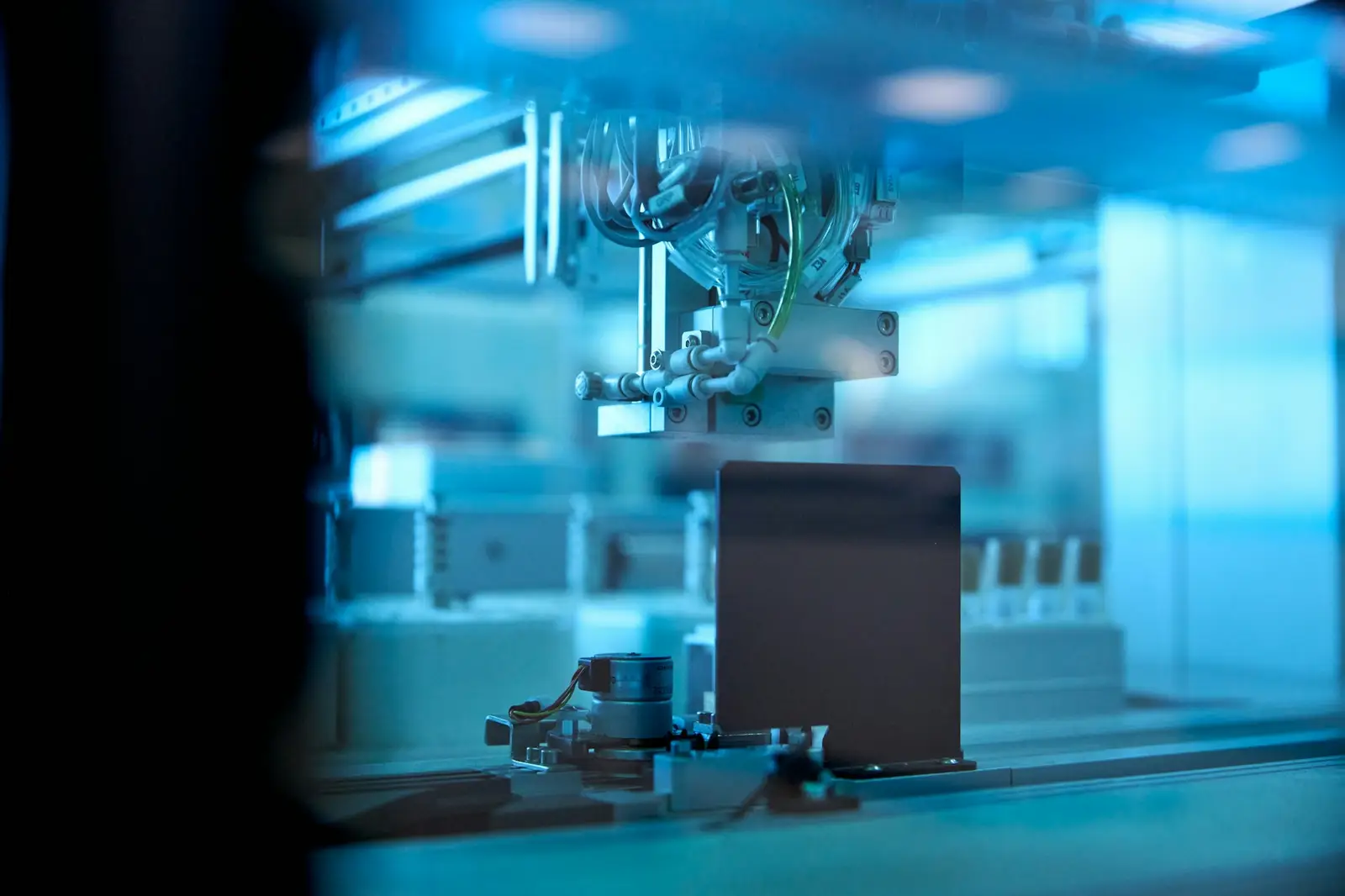 Most automation projects start small: one cell, one task, measured carefully.
Practical realities in the region
Power
Grid interruptions, voltage dips and surges remain common in many industrial areas. Robot controllers, edge PCs and cameras are sensitive to dirty power. Specify online double-conversion UPS units for controllers and compute, surge protection at distribution boards, and ensure generator changeover is tested with the automation load connected. A cobot that loses power mid-move will stop safely, but a corrupted edge PC disk or a lost PLC program will cost you days.
Environment
Heat, dust (especially in flour, cement, tea and coffee processing) and humidity shorten equipment life. Check IP ratings for cameras and enclosures, plan for cooling in control cabinets, and include cleaning in daily routines.
Skills
Kenya has a growing pool of mechatronics and electrical engineers from universities and technical institutes, but experienced robot integrators and machine vision specialists remain scarce. Plan for vendor or integrator training, and identify two or three internal "champions" (typically from maintenance and quality) who will own the system. Avoid any deployment where only the external integrator understands how it works.
Spare parts and support
Ask where spares are held. A critical gripper part shipped from Europe can take weeks to clear customs. Negotiate a local critical-spares kit as part of the contract.
Data protection
If vision cameras capture workers, the Kenya Data Protection Act 2019 applies. Position cameras to capture products rather than people where possible, document the purpose, restrict access to footage, and set retention periods. The Office of the Data Protection Commissioner publishes guidance and registration requirements.
Decision checklist: is your plant ready?
- Do you have a specific, costed problem (defects, downtime, injuries) rather than a general wish to automate?
- Is the target process stable and repeatable, with consistent product presentation?
- Can you measure the baseline today?
- Is the line's power protected, or can it be within the project budget?
- Do you have a maintenance team willing to own the system?
- Is there network connectivity to the line, segmented from office IT?
- Does the integrator offer local support and a documented safety assessment?
If you answer "no" to more than two, fix those first. They are usually cheaper than the robot.
Common mistakes
- Automating a broken process. A cobot on a line with inconsistent upstream presentation will spend its time faulting. Stabilise the process first.
- Ignoring false rejects. An over-sensitive vision system that discards good product can cost more than the defects it catches.
- Skipping shadow mode. Going live without a validation period undermines operator trust, and operators who distrust the system will bypass it.
- Cloud-dependent control. Real-time decisions routed through an internet link will fail on the first outage.
- No ownership plan. Systems without an internal owner degrade quickly as products, packaging and lighting change.
- Treating cobots as inherently safe. Safety depends on the full application: tool, payload, speed and workspace.
FAQ
Are robots affordable for mid-sized manufacturers in Kenya?
Some are. Vision inspection and condition monitoring are within reach of many mid-sized plants, and cobots are far cheaper than traditional robot cells of the past. Whether it pays back depends on the cost of your defects, downtime and manual handling. Measure those first, then get quotes; check current pricing with local distributors as landed costs vary.
Will AI robots replace factory jobs in East Africa?
In practice, early deployments tend to shift work rather than eliminate it: from manual inspection and heavy lifting to machine supervision, maintenance and quality analysis. Plan the workforce transition deliberately and involve staff early.
Do we need the cloud for industrial AI?
Not for real-time control or inspection, which should run at the edge. The cloud or a local data centre is useful for storing history, training models and comparing performance across sites. Keep the plant functional without internet access.
How long does a vision inspection pilot take?
A focused pilot on one defect type typically runs for a few months end to end, including baseline, data collection, shadow mode and go-live. Timelines depend heavily on how quickly you can collect examples of rare defects.
What is the difference between predictive and preventive maintenance?
Preventive maintenance follows a fixed schedule. Predictive maintenance uses condition data to decide when intervention is actually needed, reducing both unnecessary part replacements and surprise failures.
For a deeper look at the technology behind perception and autonomous action, read Physical AI Explained: Beyond Chatbots, and for logistics applications see The Future of Robotics in Warehousing.
How TechBytes can help
We help manufacturers scope realistic pilots: baselining OEE and defect costs, designing segmented OT networks, specifying power protection and edge compute, and integrating vision and sensor data into dashboards your team will use. We work alongside your chosen robot integrator or help you select one. Explore our AI and automation services or talk to us about the network infrastructure your plant floor needs.