Boards and CTOs are increasingly asked whether quantum computing belongs in their technology strategy. The honest answer depends on understanding what a quantum computer is good at, which is a much narrower set of problems than most coverage suggests. This article compares quantum and classical (traditional) computers across architecture, programming, reliability and cost, explains which workloads might genuinely benefit, and offers a hedged view of timelines so you can plan without either ignoring the field or overspending on it.
Key takeaways
- Quantum computers are not faster general-purpose computers. They are specialised processors that offer advantages only for problems with particular mathematical structure.
- Classical computing, including GPUs and cloud HPC, will continue to run virtually all business software, and remains the right tool for analytics, AI training, databases and transaction processing.
- Credible long-term quantum use cases include chemistry and materials simulation, some optimisation and sampling problems, and cryptanalysis.
- The most urgent business impact is indirect: future quantum computers threaten today's public-key cryptography, so migration planning should start now.
- Any realistic quantum workload will be hybrid, with classical systems orchestrating, pre-processing and post-processing around quantum steps.
The fundamental difference
A classical computer stores information in bits that are definitely 0 or 1, and processes them with deterministic logic gates. Programs are sequences of instructions, and you can inspect any intermediate value without disturbing it.
A quantum computer stores information in qubits whose state is described by complex amplitudes. Gates rotate and entangle those amplitudes; measurement at the end returns classical bits with probabilities determined by the final state. You cannot inspect intermediate values without disturbing the computation, and results are typically probabilistic, so circuits are run many times ("shots") to build up a distribution.
The power of a quantum algorithm comes from interference: arranging the computation so that amplitudes leading to wrong answers cancel and those leading to right answers reinforce. Where a problem lacks structure that permits this, a quantum computer has no edge. For a more detailed explanation of the physics, see our guide to what quantum computing is.
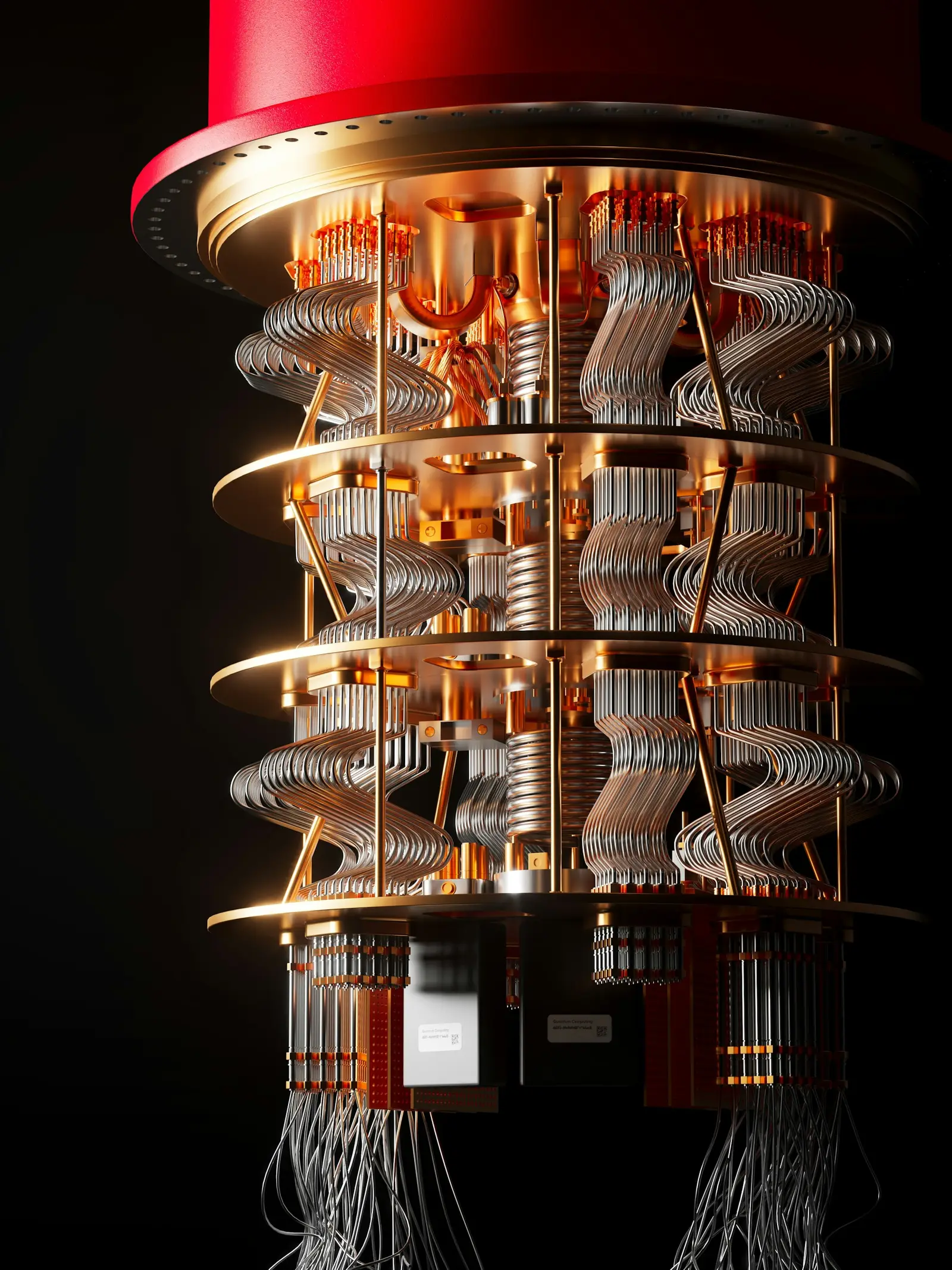
Quantum processors operate near absolute zero inside cryostats like this one.
Side-by-side comparison
| Dimension | Classical computers | Quantum computers (current generation) |
|---|---|---|
| Unit of information | Bit: 0 or 1 | Qubit: complex amplitudes over 0 and 1 |
| Core operations | Deterministic logic gates | Unitary gates; probabilistic measurement |
| Reading state | Any time, non-destructively | Only by measurement, which collapses the state |
| Copying data | Trivial | Forbidden for unknown states (no-cloning) |
| Error rates | Extremely low; errors rare | High relative to classical; error correction still maturing |
| Operating environment | Room temperature, standard data centres | Often millikelvin cryogenics, vacuum systems or precision lasers |
| Scale today | Billions of transistors per chip | Tens to a few thousand physical qubits, few logical qubits |
| Programming | Mature languages, tools, libraries | Circuit SDKs (Qiskit, Cirq and others), early-stage tooling |
| Access model | Owned, colocated or cloud | Almost entirely via cloud services |
| Best at | Almost everything: data processing, AI, transactions, web | Specific structured problems: quantum simulation, factoring, some sampling |
| Maturity | Decades of mass production | Research and early commercial stage |
Which problems benefit from quantum computing?
Strong theoretical case
Simulating quantum systems. Molecules and materials obey quantum mechanics, and the classical cost of simulating them exactly grows exponentially with system size. Quantum computers could model catalysts, battery chemistries, fertiliser production processes and drug interactions more directly. This is arguably the most natural and promising application, and the one most likely to deliver early scientific value.
Factoring and discrete logarithms. Shor's algorithm solves these problems in polynomial time on a fault-tolerant quantum computer, which breaks RSA and elliptic-curve cryptography. This is a clear, exponential speed-up, but it requires large error-corrected machines.
Plausible but unproven at practical scale
Optimisation. Logistics routing, portfolio construction, scheduling and network design are frequently cited. Algorithms such as QAOA and quantum annealing are being explored, but classical heuristics and solvers are extremely good, and convincing practical advantage on real business problems has not been established at the time of writing. Treat vendor claims cautiously and ask for comparisons against strong classical baselines.
Sampling and some machine learning tasks. There are theoretical results suggesting advantages for particular sampling problems, and research into quantum machine learning is active. Practical benefits for typical enterprise ML workloads remain speculative. Loading large classical datasets into quantum states is itself a bottleneck.
Little or no expected benefit
- Web and mobile applications, APIs and databases
- Transaction processing, including mobile money and core banking
- Training and serving large AI models
- Office productivity, ERP and CRM workloads
- Video, storage and networking
For these, classical CPUs, GPUs and specialised accelerators will remain the right tools.
Grover's algorithm: a useful reality check
Grover's algorithm searches an unstructured space of N items in roughly √N steps instead of N. That sounds impressive, but the speed-up is quadratic, not exponential. Once you account for slower quantum gate speeds and error correction overhead, many analyses conclude that Grover-style speed-ups are unlikely to beat classical hardware for practical search problems for a long time. It is a good example of why "quantum speed-up" must always be examined closely.
Hybrid computing is the realistic model
Practical quantum workloads look like this:
[Classical application]
      |
      |  1. Formulate problem, reduce size, choose parameters
      v
[Classical pre-processing on CPU/GPU]
      |
      |  2. Compile circuit, submit job via cloud API
      v
[Quantum processor: run circuit for many shots]
      |
      |  3. Return measurement counts
      v
[Classical post-processing: error mitigation, analysis]
      |
      |  4. Update parameters and loop (variational algorithms)
      v
[Result used by business application]
Variational algorithms in particular run many short quantum circuits inside a classical optimisation loop. The classical side does much of the work. In practice, an organisation that wants to experiment needs good classical engineering and data skills first.
Realistic timelines (hedged)
Timelines in quantum computing have a history of slipping, and serious researchers disagree. With that caveat:
- Now: Noisy devices with tens to a few thousand physical qubits are available through cloud services. Error correction has been demonstrated at small scale, including experiments where logical error rates fall as the code grows. Useful commercial advantage is not established.
- Next few years: Expect more logical qubits, better fidelities and early demonstrations on scientifically meaningful problems, especially in chemistry and materials. Several major vendors have published roadmaps targeting fault-tolerant systems around the end of this decade.
- Beyond that: A cryptographically relevant quantum computer, capable of breaking RSA-2048, needs large numbers of high-quality logical qubits. Published resource estimates have fallen over time; a 2025 estimate by Craig Gidney at Google suggested fewer than one million noisy physical qubits running for about a week. No machine close to that exists today, but the trend is towards lower requirements, not higher.
The key planning insight is asymmetric risk. Being early on business applications costs some money. Being late on cryptography could expose data that must stay confidential for many years.
 Security and performance both depend on what happens at the hardware level.
Cost and access from East Africa
Quantum hardware is not something an East African company should buy. The machines are expensive to build and operate, and are almost entirely accessed via the cloud: IBM Quantum Platform, Amazon Braket and Azure Quantum are examples, each with its own pricing for simulators and real hardware. Check current pricing and free tiers before running anything substantial; costs are typically charged per task, per shot or per time unit, and can be significant in USD terms when converted to KES.
Connectivity is not a barrier. Quantum jobs are submitted in batches and queue on the provider's side, so the latency between Nairobi and European or US data centres is irrelevant. What matters is having engineers who can formulate problems properly and evaluate whether results beat classical alternatives.
What a sensible first experiment looks like
If a research or innovation team does want hands-on experience, keep the first project small and measurable:
- Pick a toy version of a real problem, such as a small molecule or a tiny scheduling instance, where the classical answer is known.
- Solve it classically first and record time, cost and accuracy.
- Implement it with an open-source SDK on a local simulator, then on cloud hardware within a fixed budget.
- Compare results honestly, including noise, queue time and engineering effort.
- Write up what was learned and what problem size would be needed for an advantage.
The value of such an exercise is literacy, not a production system. It equips the team to judge future vendor pitches.
Should your organisation act now? A decision checklist
- Do you hold data that must stay confidential for more than about ten years (customer records, health data, government or financial archives)? If yes, start post-quantum cryptography planning now.
- Do you work in chemistry, materials, pharmaceuticals, energy or advanced logistics research? If yes, a small exploration budget and partnerships with universities may be justified.
- Are you being sold a "quantum" product for routine optimisation or analytics? Ask for a benchmark against a strong classical solver.
- Do you have classical HPC or GPU workloads that are not yet well optimised? That is usually a better investment today.
- Do you have at least one engineer who understands the fundamentals well enough to evaluate claims? Training is cheap insurance.
Common mistakes
- Treating quantum as a faster CPU. It is a different model of computation that helps only certain problems.
- Counting qubits alone. Fidelity, connectivity and error correction matter as much as count.
- Running pilots without a classical baseline. A pilot that does not compare against the best classical method proves nothing.
- Ignoring the cryptography timeline while focusing on speculative applications. The security impact is the nearest-term business issue.
- Buying "quantum-safe" products without checking standards. Look for implementations of the NIST post-quantum standards, not proprietary claims.
FAQ
Is a quantum computer faster than a supercomputer?
Only for specific problems with suitable structure, and only once the hardware is large and reliable enough. For most workloads, classical supercomputers and GPUs are faster and far cheaper.
Will quantum computers replace classical computers?
No. They will act as specialised co-processors accessed alongside classical systems, which will continue to run operating systems, applications, databases and networks.
Can quantum computers speed up AI?
Possibly for some specialised tasks in the long run, but there is no established practical advantage for mainstream AI training or inference. GPUs and AI accelerators remain the right investment.
What should a Kenyan SME do about quantum computing today?
For most SMEs, the practical step is to ensure your software vendors, banks and cloud providers have a post-quantum migration plan, and to keep systems updated so new cryptography can be adopted. Direct quantum projects rarely make sense at SME scale.
How TechBytes can help
We help organisations separate quantum signal from noise. Our consultancy team can brief leadership, review vendor claims and assess whether a proposed use case has a credible path to value against classical alternatives. For the cryptographic side, which is the more pressing issue for most businesses, read how quantum computing could change cybersecurity, and talk to our cybersecurity team about a cryptography inventory.