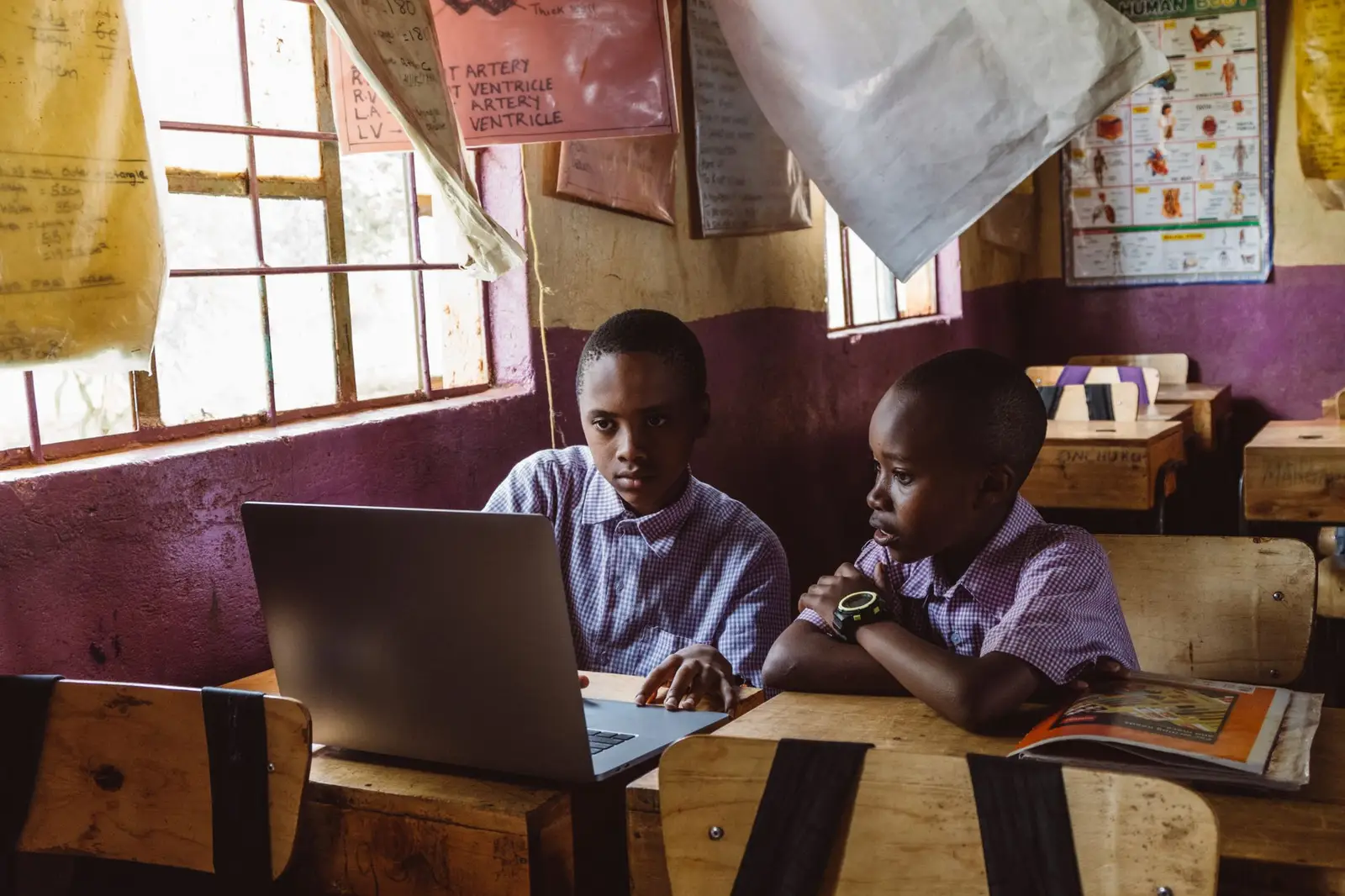
About the client
The client is an education group running four private schools: two in Nairobi, one in Kiambu and one in Mombasa. Together they teach about 3,600 learners from pre-primary to Grade 9 under the Competency-Based Curriculum, supported by around 320 teaching staff and 110 non-teaching staff.
Each school had grown up with its own IT arrangements. One used a local technician on retainer, two relied on a teacher with an interest in computers, and the Mombasa school had no formal support at all. The group's board wanted a consistent digital learning experience across all four schools and a single point of accountability for IT.
The challenge
Digital learning depended on a single computer lab per school, around 30 ageing desktops each. With timetables shared across 20 to 28 classes, most learners reached a computer for one lesson a week. Teachers prepared work on personal laptops and phones, so lesson materials and learner records sat on private devices, which created obvious data protection risks.
There was no common platform for assignments or communication with parents. Homework went out through WhatsApp groups, and teachers estimated they spent four to five hours a week on admin that could be automated.
Fee collection was slow and labour-intensive. Parents paid at the bank and sent slip photos to the bursar, who matched them against ledgers by hand. On average only 61% of fees arrived within 30 days of term opening, and reminder calls took up much of the accounts team's time each term.
Support was reactive. When a projector or laptop failed, the fix depended on whoever was available, and median resolution time across the group was about three working days.
Objectives
- Give every Grade 4 to 9 learner a managed device, and every teacher a work laptop.
- Move all four schools onto one LMS and one set of collaboration tools.
- Keep learners safe online, both at school and on school devices at home.
- Make fee payment simple for parents and reconciliation automatic for bursars.
- Equip teachers to use the tools with confidence, not just receive them.
- Provide responsive, measurable IT support under a single SLA.
Our approach
Discovery & audit
We visited each school for two days, observing lessons, interviewing heads of section, bursars and a sample of parents, and testing Wi-Fi and internet capacity in every classroom block. Two schools needed access point upgrades before any device rollout, and the Mombasa school's internet link was too small for 1:1 learning, so a fibre upgrade was added to the plan.
Design
We recommended Google Workspace for Education with Google Classroom as the LMS, because it runs well on low-cost Chromebooks, works on parents' phones and was already familiar to some staff. Teachers received Windows laptops managed through Microsoft Intune, because several departments depended on Windows-only software.
Child online safety was designed in from the start. Learner accounts were restricted by age group, external sharing was limited, and DNS-level filtering followed devices off campus. Because the Kenya Data Protection Act 2019 requires parental consent for processing children's data, we helped the group update its consent forms and privacy notice before any learner account was created.
Deployment
Rollout followed the school calendar. Infrastructure work and device enrolment took place during the April and August holidays, and learners received devices in the first two weeks of the new term, one grade at a time. One Nairobi school served as the pilot during the second term, and the other three followed in the third term once lessons from the pilot had been applied.
Solution architecture
The platform has five layers:
- Devices and management: 1,530 Chromebooks for Grade 4 to 9 learners, managed through the Google Admin console, and 320 Windows laptops for teachers in Intune with BitLocker encryption and automatic updates. Lower grades share class sets on charging trolleys.
- Learning platform: Google Classroom for assignments, feedback and resources, with shared drives per department so materials stay with the school when staff move on.
- Classroom technology: 112 interactive flat panels replacing projectors, with screen casting from teacher laptops.
- Safety and security: DNS content filtering by age group, safe search enforcement, YouTube restrictions and safeguarding alerts sent to designated staff at each school.
- Parent portal: A web and mobile portal showing fee statements, term reports and announcements, with M-Pesa STK Push payments that reconcile automatically against each learner's account.
 Staff training ran in small groups, with in-school champions supporting colleagues between sessions.
Training was delivered in three rounds: platform basics before devices arrived, lesson design with the tools during the first term, and peer-led sessions run by 24 digital champions, six per school, whom we trained and certified.
Implementation timeline
| Phase | Weeks | Key deliverables |
|---|---|---|
| Discovery & readiness | 1–4 | School audits, Wi-Fi and internet assessment, consent and policy updates |
| Platform & infrastructure (April holiday) | 5–8 | Workspace tenant, Intune setup, filtering, Wi-Fi upgrades, Mombasa fibre |
| Pilot school | 9–16 | Device issue, displays, LMS launch, first training round |
| Parent portal build | 10–18 | Portal, M-Pesa integration, finance system sync, parent onboarding |
| Group rollout (August holiday and third term) | 17–28 | Remaining three schools, champion programme, displays installed |
| Handover to managed service | 29–30 | Runbooks, SLA reporting, termly review schedule |
Results
| Metric | Before | After | Change |
|---|---|---|---|
| Centrally managed devices | 0 | 1,850 | All devices enrolled |
| Teachers using the LMS weekly | 18% | 92% | +74 pts |
| Fees paid within 30 days of term opening | 61% | 87% | +26 pts |
| Median helpdesk resolution time | ~3 working days | 3.5 hours | -85% |
Learners in Grades 4 to 9 now use their devices in most lessons rather than one lab period a week. Bursars no longer match bank slips by hand, since around three quarters of fee payments now arrive through the portal and post automatically. Fewer than 2% of devices were reported lost or damaged in the first year, helped by a simple care agreement signed by parents and learners.
What made the difference
- Consent and safety first. Settling parental consent, filtering and safeguarding before devices arrived built trust with parents and avoided later pushback.
- Teachers before devices. Training staff before learners received devices meant lessons changed from day one, rather than devices sitting unused.
- Digital champions. Peer support from colleagues in the same school proved more effective than outside trainers for day-to-day questions.
- One calendar, one rhythm. Aligning every disruptive step with school holidays kept teaching uninterrupted across all four schools.
What's next
TechBytes supports the group under a managed IT agreement with a four-hour response target, on-site visits weekly at each school, and termly reports to the board on device health, LMS adoption and safety alerts. The next phase extends 1:1 devices to Grade 3 and introduces a learner analytics dashboard so heads of section can track engagement and support learners who are falling behind.